
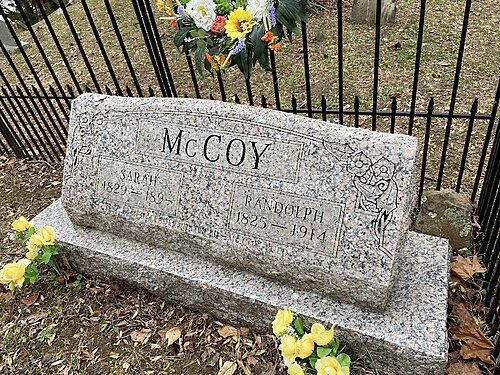

Most people who come looking for the McCoys start in the hollows along Blackberry Creek, where the worst of the feud happened. The man at the center of the McCoy side did not die there. Randolph McCoy spent his last years in Pikeville, the Pike County seat, and he lies in Dils Cemetery on a slope above the town. His wife Sarah is buried there too. For a family so tied to the creek bottoms of the Tug Valley, it is a quiet, town-edge resting place, and that contrast is part of what makes the visit worth the short climb.
A colonel's family ground
The cemetery takes its name from John Dils Jr., a merchant and Union officer who settled in Pikeville before the Civil War and raised a regiment of Kentucky infantry for the Union during it. The ground began as his family's burial plot and grew into a town cemetery over the following decades. Dils himself is buried here, along with several generations of Pikeville families whose names still appear on street signs and storefront deeds in the valley below.
Older stones lean at gentle angles. Some carry carved hands, weeping willows or lambs; others are plain slabs whose inscriptions have weathered close to blank. Newer markers stand among them, so the place reads less like a museum and more like what it still is: a working burial ground with a long memory.
Why the cemetery is unusual
Dils Cemetery is often described as one of the earliest integrated cemeteries in eastern Kentucky. From early on, Black residents of Pikeville were buried here, and the graves were not fenced off into a separate corner in the way that many Southern burial grounds of the period required. The usual account credits Colonel Dils with allowing those burials on his land, and the cemetery's listing on the National Register of Historic Places reflects that history as well as its age.
That detail tends to surprise visitors who arrive thinking only of the feud. It is worth slowing down for. The stones of formerly enslaved people and their descendants sit within the same hillside as the merchants, soldiers and feud families, and reading the names together gives a fuller picture of who built Pikeville than any single story can.
Randolph and Sarah McCoy
Randolph McCoy, often called Ranel or Old Ranel, was the father of a very large family; most accounts give him and Sarah some sixteen children. The feud took a terrible share of them. Three of his sons, Tolbert, Pharmer and Randolph Jr., were killed by Hatfield men in August 1882 after the election-day fight that left Ellison Hatfield dying. On New Year's night in 1888, raiders set fire to the McCoy cabin on Blackberry Creek; his daughter Alifair and son Calvin were shot dead, and Sarah was beaten so badly she was left crippled. The story of that night is told in full in the New Year's raid.
After the raid, the family left the creek and moved into Pikeville, where they could live closer to the law and to the courts that were trying the Hatfield men. Randolph outlived most of the principal figures on the McCoy side. He died in 1914, in his late eighties, after being badly burned in an accident at a cooking fire; accounts differ on the exact details of that day. He was buried in Dils Cemetery, near Sarah.
Randolph and Sarah share a single gray granite headstone, carved with the family name and set inside a low iron fence. Visitors often leave flowers there. If you want to leave something, a single flower is enough. Leave nothing that will blow loose or need tidying later. For his whole life story, from the hog dispute to his years in town, read our portrait of Randolph McCoy.
Another stop · Sarah AnnThe Hatfield Cemetery and Devil Anse's statueReading the hillside
The cemetery climbs in rough terraces. Paths are a mix of grass and worn earth, and some rows are tight enough that you have to step carefully between stones. A few things help you make sense of what you see:
- Look at the dates first. Clusters of deaths in the same year often point to an epidemic, a flood or a mine disaster rather than to the feud.
- Notice the stone types. Hand-cut sandstone tends to be older; polished granite usually means a later replacement or a newer burial.
- Find the view. From the upper rows you can see down to the town in its bend of the Levisa Fork and, beyond it, the deep slot of the Pikeville Cut-Through.
The view explains the town in a single look. Pikeville grew where the river curved and the valley floor widened just enough for streets and a courthouse. The great cut through the ridge, finished in the 1980s, moved the river, the highway and the railroad out of that loop. The story of the town below is in our guide to Pikeville and the McCoy side of the valley.
Pikeville, slowly
Dils Cemetery is a place where families still come to tend graves. Treat it that way. Keep voices low when others are present, keep off the stones themselves, and do not make rubbings: old sandstone flakes easily, and repeated rubbing wears inscriptions away. Photograph from the paths. Pets, if you bring one, stay leashed and away from the plots.
The lane up from town is steep, narrow and paved in places, rougher in others. Parking is limited to a few pull-offs, so a smaller car is easier, and in wet weather or ice the grade can be slick. Go in daylight. There are no facilities on the hill, so plan water and a rest stop in town before you climb.
Opening times and access arrangements are set locally and can change, especially around maintenance or bad weather.
Fitting it into a day
Pair the cemetery with a walk through downtown Pikeville and the courthouse square, where the trials that ended the feud's courtroom chapter were held. A morning at Dils Cemetery and an afternoon on the town's streets fit easily into one day. From there, the drive east toward the Tug and the Hatfield side of the river makes a natural second day; the route and timing are set out in our driving plan for feud country.
Spring is the gentlest season here: the grass is cut, the dogwoods are out on the slope, and the paths are dry by late morning. October brings color on the ridges and clear air for the view. Summer heat on an exposed hillside can be hard going by midday, so come early.
Whatever the season, the visit is short and quiet. A few minutes at the McCoy graves, set against everything the family lived through, usually says more about the feud than any reenactment.
Back to Graves and homeplaces